
The Argument Nobody Wins Because Both People Are Right
On oxytocin, vasopressin, and why two people who love each other keep missing each other. The neuroscience of why you both feel abandoned in the same argument.


Picture this.
Something happens. An argument, a silence, a moment where something felt off between you and another person. It doesn’t have to be a big thing. It rarely is…
One of you needs to talk about it. Needs to say it out loud, to feel the other person close, to know that the connection is still there. The talking is not about solving anything. It is about making sure you are still okay. Still together. Still safe.
The other one needs to step back. Needs quiet, space, time to process somewhere internal before they can come back and be present. The distance is not about punishment or indifference. It is about regulation. About getting back to a place where they can actually function.
Both responses are intelligent.
Both responses are nervous system responses to threat.
And both responses make the other person feel abandoned.
This is not a communication problem or a compatibility problem.
It is two different stress responses trying to find safety in the same moment and reaching in opposite directions.
What stress actually does
When the nervous system registers threat, and in close relationships threat can be as subtle as a shift in tone or a few hours of unusual silence, it mobilises.
But mobilisation doesn’t look the same in every nervous system.
For some, the stress response activates a move toward connection.
Talking, proximity, reassurance, contact. The nervous system is trying to regulate through other people. Through co-regulation. Through the felt sense that someone is there and the connection is intact. This is sometimes called the tend-and-befriend response, a stress pathway that orients toward social affiliation rather than fight or flight (Taylor et al., 2000).
For others, the stress response activates a move inward.
Withdrawal, quiet, space, solitude. The nervous system is trying to regulate through internal processing. Through reducing stimulation. Through getting below the activation threshold before re-engaging. This is not avoidance in the clinical sense.
It is a different architecture of self-regulation.
Neither is wrong. Neither is a character flaw. They are two different ways the nervous system learned to return to baseline.
The problem is what each one looks like to the other person…
The translation problem
To the one who moves toward, the one who moves away looks like they don’t care. Like the relationship doesn’t matter enough to fight for. Like silence is a verdict.
To the one who moves away, the one who moves toward feels like pressure being added to an already overwhelmed system. Like being chased into a corner. Like the only options are to say something they don’t mean yet or to shut down entirely.
So the one who moves toward pursues a little harder. Needs a little more contact to feel safe. The one who moves away retreats a little further. Needs a little more space to come back.
And both of them end up feeling more alone than before the conversation started.
This is the cycle. Not malice. Not indifference. Two nervous systems doing exactly what they were built to do, in opposite directions, in the same moment.
Where it comes from
Stress response patterns are not random. Like the relational blueprint, they are shaped early.
The tend-and-befriend response, the move toward connection under stress, tends to develop in environments where co-regulation was available and safe. Where reaching for someone worked. Where proximity meant comfort.
The inward withdrawal response tends to develop in environments where self-reliance was more reliable than reaching out. Where being seen in distress was unsafe or uncomfortable for others. Where the most effective thing to do with a difficult feeling was to take it somewhere private and manage it alone.
Neither person chose their stress response. It was built for them, by their history, long before this relationship.
Which means when you are in the middle of that moment, one reaching, one retreating, neither of you is doing something to the other. You are both doing something that once kept you safe.
What is happening underneath
This is not just psychology. There is biology underneath it too, and it matters because it explains why the pattern can feel so involuntary, so automatic, so completely beyond the reach of intention or goodwill.
When the nervous system registers a relational threat, both people experience a stress response. The same hormonal cascade, the same activation of the hypothalamic-pituitary-adrenal axis, the same release of cortisol and adrenaline.
The physiological starting point is identical.
What diverges is what happens next.
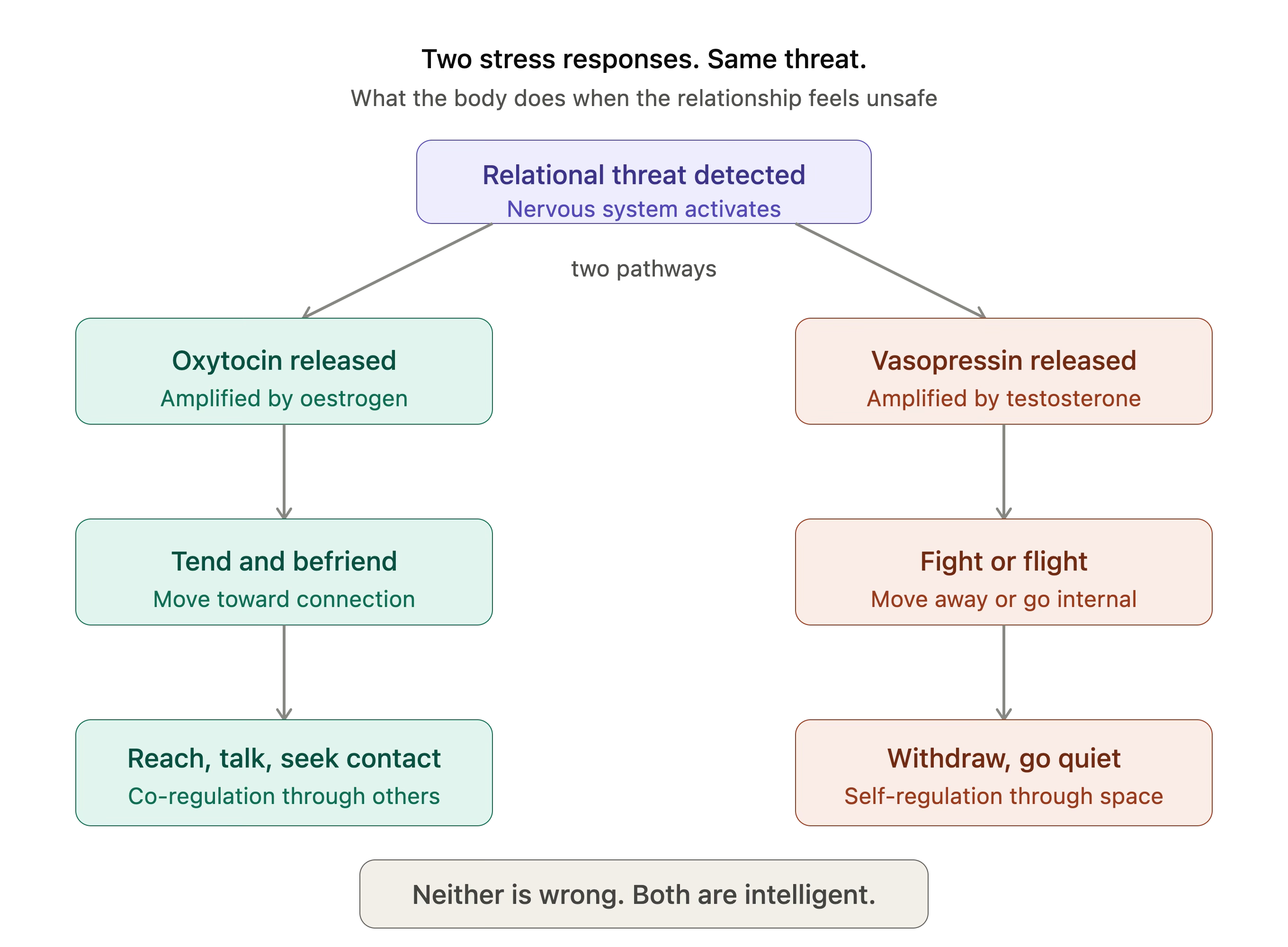
Research suggests that higher levels of oestrogen amplify the effects of oxytocin, the bonding and affiliation hormone, under stress.
The result is a stress response that orients toward connection. Toward talking, proximity, reassurance. Toward the presence of another person as the primary route back to safety. This is sometimes called the tend-and-befriend response, a biobehavioural stress pathway that draws on the attachment and caregiving system rather than pure fight or flight (Taylor et al., 2000).
Higher levels of testosterone, by contrast, are associated with vasopressin, a neuropeptide linked to vigilance, territorial behaviour, and self-protective withdrawal under threat.
The stress response here orients inward, or outward in the form of conflict, rather than toward social affiliation. Testosterone has also been shown to suppress oxytocin release under stress, which may reduce the pull toward connection at precisely the moment connection is most needed (Bredewold & Veenema, 2018).
Neither pathway is a personality flaw. Both are ancient biological responses shaped by evolutionary pressures long before modern relationships existed.
What this means in practice is that two people in the same argument may be running completely different neurochemical stress responses. One nervous system is flooded with oxytocin and reaching for contact. The other is flooded with vasopressin and pulling toward space. Both are trying to regulate. Both are doing exactly what their biology is orienting them toward.
And neither one knows that the other is in a completely different internal state.
A critical caveat, and this matters clinically: these are tendencies, not rules.
Hormonal profiles vary significantly between individuals regardless of gender. Stress response patterns are shaped by history, attachment, and experience as much as by biology. The research points to patterns at a population level, not fixed individual destinies.
Some people whose biology skews toward oxytocin under stress will still have learned to withdraw because withdrawal was safer. Some people whose biology skews toward vasopressin will have learned to reach out because connection was available.
Biology sets a tendency. History shapes the expression of it.
Both matter. Neither is the whole story.
What this actually asks of you
This is not a post about fixing the pattern.
You cannot think your way out of a nervous system response in real time.
But there is something that helps.
It is the moment you stop reading the other person’s stress response as information about how much they care.
The one who moves away is not telling you the relationship doesn’t matter. They are telling you their nervous system needs internal space to come back to you.
The one who moves toward is not telling you they are too much or too needy. They are telling you their nervous system needs contact to feel safe enough to regulate.
When you can hold that, even imperfectly, even just for a moment before the old story kicks in, something has opportunity to shift.
Not because the nervous system responses change immediately. But because the meaning changes.
And meaning is where the real damage happens.
The question worth sitting with
Think about the last time you and someone you care about missed each other in an argument or a silence.
Which one were you? The one who moved toward or the one who moved away.
And what story did you tell yourself about what the other person’s response meant about you?
That story, not the stress response itself, is where the work lives.
Welcome to the Safety Revolution
I am so glad you are here.
Kat
If this landed, share it with someone you keep missing.
And if you want to go deeper into what it actually takes to meet each other across different nervous system responses, that’s what the Inner Room is for next post.
References
Alexander, F., & French, T. M. (1946). Psychoanalytic therapy: Principles and application. Ronald Press.
Barrett, L. F. (2017). How emotions are made: The secret life of the brain. Houghton Mifflin Harcourt.
Bowlby, J. (1988). A secure base: Parent-child attachment and healthy human development. Basic Books.
Bredewold, R., & Veenema, A. H. (2018). Sex differences in the regulation of social and anxiety-related behaviors: Insights from vasopressin and oxytocin brain systems. Current Opinion in Neurobiology, 49, 132–140.
Freud, S. (1920). Beyond the pleasure principle. International Psycho-Analytical Press.
Schacter, D. L. (1987). Implicit memory: History and current status. Journal of Experimental Psychology: Learning, Memory, and Cognition, 13(3), 501–518.
Squire, L. R. (1992). Memory and the hippocampus: A synthesis from findings with rats, monkeys, and humans. Psychological Review, 99(2), 195–231.
Taylor, S. E., Klein, L. C., Lewis, B. P., Gruenewald, T. L., Gurung, R. A. R., & Updegraff, J. A. (2000). Biobehavioral responses to stress in females: Tend-and-befriend, not fight-or-flight. Psychological Review, 107(3), 411–429.
Young, J. E., Klosko, J. S., & Weishaar, M. E. (2003). Schema therapy: A practitioner’s guide. Guilford Press.